
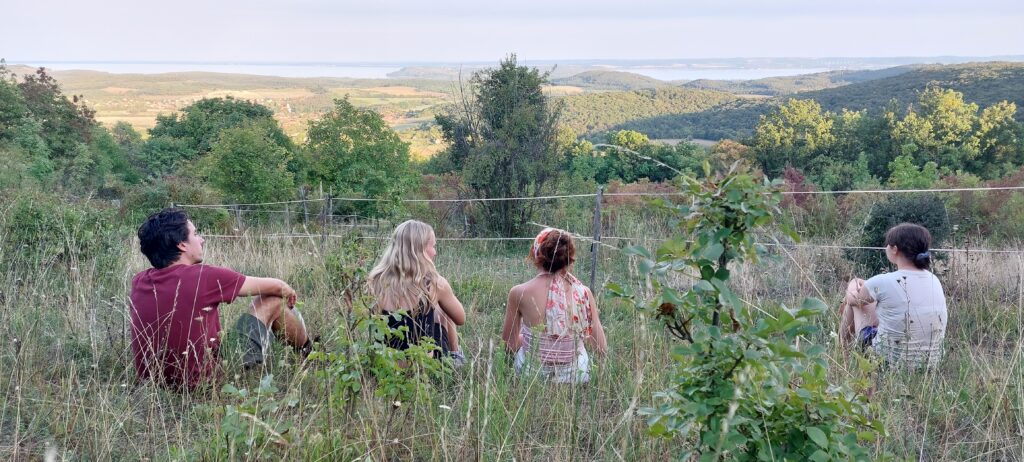
Volunteering in Cold Hill Shelter
Our goal is for volunteers to gain experience outside their comfort zone and learn about the possible simple and gentle way of rural life, to practice the processes necessary for life on a daily basis, to gain experience in ecological farming and construction, and to develop their cooperation and self-awareness skills.
The main focus of the planned activities is to deepen the knowledge gained through experiential exercises and learning processes of the method, tools and implementation of ecological farming and living space. By applying the permaculture design model, the ecological approach and methods that fit into the order of nature, we create a landscape use culture that increases ecological diversity, is water-retaining and regenerative, and helps the consciously cooperative lifestyle of people living in the landscape, creates healthy food, habitats and living spaces.
- We have created a 42 m diameter circular garden for growing vegetables, protected by a game fence, with beds formed along contour lines. During the gardening process from spring to autumn, we prepare beds, sow seeds, plant and stake seedlings, build a drip irrigation system, care for our plants, compost, harvest, loosen, fertilize and mulch the soil. We grow both vegetables and fruits in the garden in a polyculture system cultivated with permaculture and biointensive methods.
- We increase the fruits with noble canes grafted onto local wild plants or by planting, we take care of their game protection, fertilization, irrigation and crown-shaping pruning.
- Among our pets, we already have hens who give us our daily eggs, we feed them, water them on a daily basis, and provide them with a favorable habitat. We plan to fence our grassland areas suitable for grazing with electric fences to make them suitable for cattle.
- We create the necessary structures for our life and farming using natural methods, so we build dry-laid stone retaining walls, tapped wooden structures, we plaster with adobe, plaster and build with lime mortar, we build ecological tools, and we develop a network-independent system.
Living conditions provided for volunteers
- Accommodation: in the cool season (March-April, September-October) in a yurt heated with a wood-burning mass stove, in the warm season (May-August) in a glamping tent or in the cool rooms of old stone houses.
- Bathing, toilet, washing: in the frost-free season (March-October) you can use the garden hot water shower, instead of a toilet we use an outdoor compost toilet, washing is possible with a local automatic washing machine.
- Kitchen and meals: in the cool season there is a possibility to cook in the yurt, in the warm season we use the community summer kitchen, the ingredients are provided.
- Knowledge transfer and communication: we are also looking for volunteers who would like to participate in local knowledge transfer processes, or use multimedia tools (by creating images, videos, audio materials, documents) to help the widespread access of locally generated knowledge materials (know-how, storytelling) through social media platforms (facebook, instagram, …).
Location
Pécsely is a pictoresque village 15 km north from Lake Balaton, with 560 inhabitants. Our community is located above the village in a 6 hectare area, with a breathtaking view on the Balaton-lake. Our community consists of 5 permanent members and around 10 local families who we cooperate with.
Activity description
Mindenegyüttmegy Association in Pécsely is a community of people who changed urban life to a rural life that fosters a sustainable world through organic food production, eco-architecture, dialogue between the rural and the urban, a festival and community spaces.
You will be participating in the community’s activities as follows:
- outdoor tasks (gardening, taking care of animals, use landscape, etc.)
- planning local community and volunteer initiatives
- participating in the eco-architecture projects, especially developing the “Hideg-hegy” (Cold-hill) shelter, as a community space for learning, healing, culture and workshops, and as a self-sustainable eco farming for producing healthy food for the locals.
- taking part in camps and eco-events organized by the community
- cooperating in the daily tasks of the community members – tasks that are part of living in such an environment, application of community cooperation methodologies (project and task planning, local roles, division of tasks, scheduling, taking responsibility)
- cooking on events, and joint cooking every day
- harvesting and conserving products of the garden
- creating posters, photos and different visuals, creating input and maintaining social media platforms